

A clear yes! This is a serious problem, especially with older, high-compression engines.
Higher compression increases the engine’s efficiency and thus its specific power output. However, higher compression also increases the risk of knocking—the term for uncontrolled combustion that occurs before the intended ignition point. If the engine knocks (which can often, but not always, be heard), it will suffer damage. The higher the octane rating, the lower the risk of knocking.
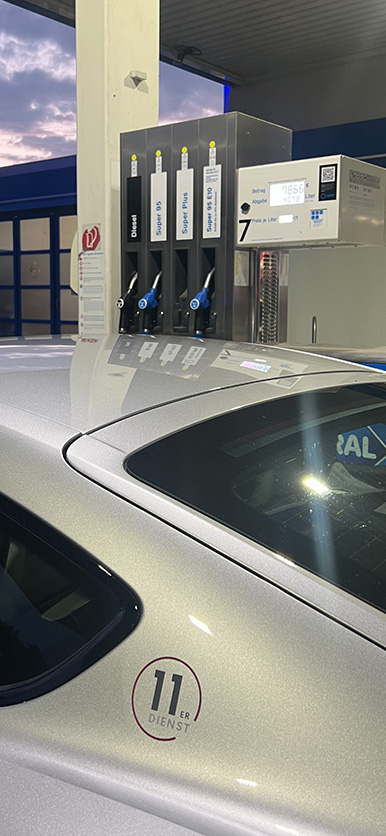
Good old regular fuel is no longer available, but Super and Super Plus are. Super Plus often has 98 octane, and some manufacturers offer fuels with up to 102 octane. This octane rating refers to fresh fuel and is sufficiently stable during normal, continuous use. However, as fuel ages, the very components responsible for the high octane rating evaporate first—Super Plus becomes Super, eventually you have that good old regular again, and at some point, the engine won’t even start with the ancient gasoline!
Newer engines feature so-called knock sensors; these can measure uncontrolled combustion and “retard” the ignition. This allows knocking to be largely avoided even with poorer fuel quality. Porsche introduced knock sensors as early as the Porsche 928 and 964.
The high-compression, early sports engine that is rarely driven is particularly at risk. The vehicle was fully fueled before being stored, brought back to life very carefully after a long time, and, of course, warmed up just as carefully. But then the time comes, everything is running, and it has to show what it’s made of on the highway, but somehow it used to run better…? Anyone who continues to push the engine hard with old fuel could soon lose all joy in it. First, the upper edge of the piston—the ring land—disintegrates, a progressive process that gradually leads to major engine failure.
In principle, these correlations apply to almost every engine, though in a much weaker form.
What is the advice? Drive the vehicle at least every 6 months; do not just warm it up carefully, but only demand full performance once it has fresh gasoline.
Incidentally, the 6-month rule has proven to be a good rule of thumb; until then, classic damage from standing remains within clear limits.